Common Ground United and Drilling Santa Fe have composed a county outreachworksheet for the Santa Fe County Oil & Gas Ordinance. Theworksheet is a basic suggested guide and may not be fully comprehensive. It is designed for citizens' participation in the planning process. Feedback is welcome.
Thanks to Environmental News for New Mexicans for informing us about the upcoming event, "in Santa Fe, New Mexico, Nov. 16 - 18, 2008 for the IOGCC (Interstate Oil & Gas Compact Commission) Annual Meeting. The overall theme of this year’s meeting is 'The Challenges of Unconventional Oil & Natural Gas' a topic at the forefront of national attention." Wonder if the "challenges" will fully address the adverse impacts?
Recently, Pat Lyons, Commissioner of Public Land, wrote an Op Ed calling for drilling of Otero Mesa.
Now, the State Land Office has put nearly 13,000 acres of the beautiful, agricultural land in MoraCounty up for oil & gas lease auction. MoraCounty residents had requested that this not occur. Oil & gas drilling activity poses threats to this agricultural county. More information will be forthcoming, along with action alerts.
at the Eldorado Community Center Railroad Room for a dialogue with incoming County Commissioner-elect (dist 5) Liz Stefanicsand invited guests Commissioner Jack Sullivan and Commissioner-elect (dist 4) Kathy Holian
Liz and guests will discuss
areas of mutual concern. Our primary focus will be on energy issues - potential gas and oil drilling in Santa FeCounty, and developing a local sustainable energy future. This is an extraordinary opportunity to talk with our elected representatives about the future of our community.
Hosted by the Eldorado Gas & Oil Team (EGOT!), the meeting
is part of their Resident Information Program. Space is limited to 60 people.
..."Last year, the New Mexico Environmental Improvement Board created a new rule mandating the oil and gas industry report its carbon emissions. That rule is just a first step; it still doesn’t require that industry actually reduce its emissions.
According to Schlenker-Goodrich—who represented a coalition of environmental groups that worked with the state and industry to create the new rule—the oil and gas industry has a significant footprint in terms of greenhouse gas pollution and has an obligation to reduce those emissions. Beyond that, however, he says that if industry leaders start tracking emissions, they will have further incentive to keep those waste gases, particularly methane, within the system and make the energy production system more efficient.
“So when we’re talking about greenhouse gas pollution from the oil and gas industry, the solutions to that problem not only deal with climate, but they also deal with energy,” he says. “In terms of that, if you put those solutions into motion, into practice—if you implement them on the ground in the gas patch, in the oil patch—then you put more of the product in the pipeline for consumers.”
Schlenker-Goodrich also represents activists trying to change how the federal government allows oil and gas development on public lands to occur. (Currently, the US Bureau of Land Management has 5.4 million acres of public lands leased to oil and gas companies in New Mexico alone.)
Activists have asked the BLM to quantify greenhouse gas pollution from federally-authorized oil and gas operations and consider measures to reduce that pollution. Although the agency rejected the coalition’s challenge to the April oil and gas lease sale, activists have now contested the July sale.
Despite the magnitude of the problem—and the federal government’s stubborn resistance to confronting climate change—Schlenker-Goodrich harbors a fiercely optimistic streak. “We’ve become a nation of pessimists at some level—and that’s only a recent phenomenon,” he says. ‘We truly are a nation that has historically prided itself on being self-reliant, prided itself on having a can-do attitude—and perhaps at no time in our history, have those two values, our self reliance and our can-do attitude, been more important.”
Being engaged and educated on the issue of climate change is crucial, he says. But focusing on local community is important as well. People can make use of energy resources available in their own backyards—such as solar and wind—and stop relying on coal-fired power plants hundreds or thousands of miles away whose electricity is transmitted across inefficient lines. Working with local and state governments—and forcing them to become accountable—is key to a sustainable future.
“If we think long term, if we get out of this vicious trap of crisis-by-crisis management and really take in the long view, I think we can really do it here in New Mexico,” Schlenker-Goodrich says. “Frankly, I’m optimistic…It’s going to be a lot of hard work, but its going to be a lot of good work.”' Full article>>>>
SANTA FE (2008-08-25) -- A local citizens group says it has found an anomaly with the way Santa Fe County is reporting the meetings it's having with local groups on oil and gas drilling.
A few quick corrections that jumped out at me: The grassroots organization is Drilling Santa Fe at drillingsantafe.org. It was listed as No Drilling Santa Fe on the Santa Fe County documents. Also, when I spoke of a county energy plan, it was not to be in lieu of a growth management plan, but as part of the growth management plan.
"Santa Fe - August 22, 2008 - Santa Fe County anticipates a first draft of a new ordinance concerning oil and gas extraction within 60 days and an Area plan for the Galisteo Basin in late September. Once the draft is complete, it will be made available for public comment and then dates will be set for at least two public hearings.
Lists of individuals/organizations met with during public outreach, copies of sign-in sheets, and minutes of meetings with community stakeholders and other groups are available for review at www.santafecounty.org/oilandgas. Documents being reviewed by County staff and the consultant team (www.ourplanningworks.com/santafe/SantaFeDataLog%207.10.08.pdf) during this process are available for public review in the County legal office. Documents on the list that are not available in the County legal office can be obtained from Planning Works via public records request (click here)."
This is a review of the “documentary,” "The Great Global Warming Scandal," a film shown today at the New Mexico State Land Office. According to Wikepdia, “Documentary film is a broad category of visual expression that is based on the attempt, in one fashion or another, to "document" reality.” This film might be closer to the opposite. It is thick with sarcasm and thin on fact.
Even Dr. Robert Balding, author of “The Satanic Gases: Clearing the Air About Global Warming,” commented afterwards that he did not agree with the film in some areas. One of the core arguments was that rising temperature precedes elevated CO2 levels. Dr. Balding disagreed.
Another core argument in the film is that sun spots was the climate change culprit. Dr. Balding suggested that sun spots are not solely responsible for climate change. In fact, he can not predict what will happen. He allowed that the dynamics are complex.
The main thrust of the film is to cast doubt upon climate change and the harmful impacts of CO2. If climate change does not exist and anthropogenic CO2 emissions are safe, then there need not be regulations or penalties for industry. Consequently, efforts to limit, reduce or eliminate anthropogenic CO2 emissions is anti-capitalistic, even neo-Marxist. Yet, those of faux-free-enterprise do not embrace the green entrepreneurship that is occurring globally.
Beyond blaming the media for the “global warming scandal,” the film is aggressively anti-environmentalist. In fact, it blames environmentalism for the poverty in third worlds.
In an impoverished area in off-the-grid Africa, there was a scene where a doctor had a choice between using a light or a refrigerator that contained medications. The building only had two small, under-producing solar panels, so it had little electric power for either. With strained logic, the film implied that solar power was “experimental” and only for the rich.
The film indicates that environmentalism denies Africans the use of their own resources and was perpetuating poverty. However, there was not a connection made between poverty and environmentalism. It was more a leap of logic. One such leap is that fossil fuel must be used to generate electricity in Africa and create prosperity.
Yet, who benefits from the oil drilling, such as in Nigeria?
"Santa Fe County spokesman Stephen Ulibarri admitted Thursday that the county has not been following its own rules when it comes to properly posting agendas for upcoming meetings.
Ulibarri's statement came after local radio station KSFR alleged the county violated the Open Meetings Act by failing to post a notice or agenda for a Community Development Review Committee meeting held Aug. 5.
The station's reporters missed attending the CDRC meeting — at which an attorney hired to advise the county on oil and gas development spoke — because information about the meeting was not posted on the county's Web site, KSFR said Thursday.
When first contacted by The New Mexican, Ulibarri said the county did not have a legal obligation to post notices on the Web site. He said the county had complied with the law by posting a legal notice in the newspaper.
But upon closer examination of the county's own resolution on the topic, Ulibarri acknowledged it requires agendas be posted online three days before meetings. " More>>>>
"Cathy Behr says she won't forget the smell that nearly killed her. An emergency-room nurse in Durango, Colo.'s Mercy Regional Medical Center, Behr was working the April 17 day shift when Clinton Marshall arrived complaining of nausea and headaches. An employee at an energy-services company, Weatherford International, Marshall, according to Behr, said that he was caught in a "fracturing-fluid" spill. [Fracturing chemicals are routinely used on oil and gas wells where they are pumped deep into the ground to crack rock seams and increase production.] The chemical stench coming off Marshall's boots was buckling, says Behr. Mercy officials took no chances. They evacuated and locked down the ER, and its staff was instructed to don protective masks and gowns. But by the time those precautions were enacted, Behr had been nursing Marshall for 10 minutes--unprotected. "I honestly thought the response was a little overkill, but good practice," says Behr, 54, a 20-year veteran at Mercy.
A few days later, Behr's skin turned yellow. She began vomiting and retaining fluid. Her husband rushed her to Mercy where Behr was admitted to the ICU with a swollen liver, erratic blood counts and lungs filling with fluid. "I couldn't breath," she recalls. "I was drowning from the inside out." The diagnosis: chemical poisoning. The makers of the suspected chemical, Weatherford, tell NEWSWEEK that they aren't sure if their brand of fracking fluid can be blamed for her illness."...
SANTA FE (2008-08-21) -- KSFR News has asked the state attorney general's office to investigate whether Santa Fe County has violated terms of the New Mexico Open Meetings Act.
News Director Bill Dupuy says KSFR reporters missed attending an open public meeting of the County Development Review Committee because the time, date and agenda for the August 5th meeting were not posted on the county's website. KSFR had attempted to find out about a rumored discussion of oil and gas drilling in Santa Fe County. It was not until after the meeting had taken place that the reporters found the discussion had taken place at the open meeting.
The county commission requires that notices of regular and special meetings of all committees be posted in advance on the county's website in addition to newspaper legal notices.
On further investigation, KSFR News discovered that there were no such meeting notices for that committee for the period between March 2007 and August of this year.
An earlier analysis by KSFR News found that Santa Fe County's efforts to communicate publicly about its work on an oil and gas drilling ordinance have been far less robust than similar planning projects underway in Boise, Idaho, and Grand Junction, Colorado.
Yesterday, in a unanimous vote the Rio Arriba Board of County Commissioners extended the expiring oil & gas drilling moratorium for an additional 180 days. The story was carried in the Santa Fe New Mexican under news in brief. Also yesterday, the Las Cruces City Council adopted a resolution to protect Otero Mesa. Yet, Pat Lyons, Commissioner of Public Lands, says drill the Otero Mesa. The Las Cruces resolution adoption story was carried by KSFR and AP.
Energy may be one the biggest issues facing New Mexico and beyond. There are profound events in regards to energy happening in New Mexico. And beyond New Mexico, there are citizens protesting that industry has gone too far in Fort Worth and in the Delaware Basin.
"We want to destroy environmentalists by taking away their money and their members,"
"If chlorflourocarbons really destroy ozone, why isn't there a hole over chlorflourocarbon factories, he asks". As for the greenhouse effect he was emphatic: "There isn't any such thing".
"We are sick to death of environmentalism and so we will destroy it. We will not allow our right to own property and use nature's resources for the benefit of mankind to be stripped from us by a bunch of eco-facists,"
"And that sword has two purposes: to carve out a niche for your agenda, to reshape the American law in your image; and, kill the b(lank)s."[5] Asked to describe how he would like others to think of him, he said "People in industry, I'm going to do my best for you. Environmentalists, I'm coming to get you."
"We're out to kill the fxxxers. We're simply trying to eliminate them. Our goal is to destroy environmentalism once and for all"
CARE, Citizens' Alliance for Energy Responsible, founded in part by Ron Arnold, and other aggressively pro oil & gas drilling advocates, have sent a letter to the "Gang of Ten Coalition," promoting more drilling: "Any legislation which rejects proposals to expand oil and gas drilling, and other energy development on federal lands, prevents progress towards lessening America’s dependence on foreign oil."
In short, expanding domestic drilling will not make America foreign oil independent. If one word were to sum up the impetus for more off shore drilling and costly oil shale mining and drilling -- greed. Also, see post:
Also known as oil sands, tar sands are grains of sand intermixed with bitumen (heavy, black, asphalt-like oil). The oil locked up in tar sands requires drastic efforts to extract, and the result is a particularly dirty form of energy production.
The most effective way to cut our dependence on dirty fuels -- like tar sands oil -- is to use less gasoline and diesel. If all vehicles in the U.S. averaged 40 mpg, there wouldn't be a need for tar sands oil.
Chiefs from three provinces and the Northwest Territories made the joint declaration Sunday at the conclusion of a water conference in Fort Chipewyan. They say Alberta's oldest European settlement is on the brink of catastrophe.
LA Times' Edward Silver looks at some of the private companies that could become big players in the search for energy solutions -- and eventually make their way to the public market.
In a unanimous vote the Rio Arriba Board of County Commissioners extended the expiring drilling moratorium for an additional 180 days. The extension will continue to apply countywide. John Zent, speaking for ConocoPhillips, several residents of the Lindrith area plead before the Commission to limit the moratorium to the Rio Chama watershed area. Stephanie Reed speaking on behalf of the New Mexico Oil and Gas Association echoed support for a division of the County into an eastern and western area to differentiate between the watershed (east) and developed (west) areas.
However, Gabriel Boyle, representing the County Planning and Zoning department reccomended to the Commission that the moratorium extension not be amended and apply to all "...surface over which the County has jurisdiction, including the developed areas." Attorney's Adan Trujillo and Frank Herdman summarized the progress to date on drafting the governing ordinance for oil and gas, and each recommended that the process go forward in a deliberate manner so as to allow time for careful consideration of all elements, including cultural issues. Mr. Boyle also emphasized the importance of the planned workshops for public and industry output, "...as a critical part of the process."
Commissioner Felipe Martinez discussed the length to which the Commissioners had worked and wrestled with the considerations of individuals affected, such as the Lindrith contracting concerns, and the overall responsibility to insure public water source safety and environmental impact. "Yes, the Rio Chama is a critical watershed, and perhaps parts of the County should just not ever be drilled. But, really, the entire County is a watershed. We must consider that as we move forward.
Both Commission Chairman Alfredo Montoya and County Manager Lorenzo Valdez expressed optimism that industry and government could work together and used the recent County Fair and 4-H Livestock sale in which the energy contributors have begun supporting the youth. "In 2006, we had only minimum participation from the oil and gas community, about $2,700. Last year, in response to a County outreach project, industry greatly increased their participation, to $26,000 and this year, another big increase to a total of over $37,000," said Montoya. Manager Valdez added that in addition to the huge increase, two of the energy contributors, Devon Energy and M&R Trucking were donating three steers back to community service organizations. "El Mirador for the handicapped; Esperanza for domestic violence; Hoy Recovery for substance abuse, all very important and deserving programs for the community. It's just an example of how we can work together for mutual benefit," said Valdez.
"August 18 - In the most recent segment of his interview, The Real News senior editor Paul Jay discusses disaster capitalism with Naomi Klein, author of The Shock Doctrine.
Using the current high oil prices as an example, Klein explains that disaster capitalism is what she calls the ideological political strategy in which politicians use disasters to help push through unpopular policies, such as privatization and cuts to government spending. There is "a very deliberate change of topic coming from the oil and gas industry to get all of the focus on high gas prices and present a policy alternative that will not solve the prices, but will be certainly in the economic interest of the oil and gas industry, which is to allow drilling the continental shelf in Anwar."
Previous efforts to gain support for drilling in Anwar have failed because there could be serious environmental repercussions, but Klein believes that will soon change. "If you get all the people on corporate TV just reiterating the talking points of the oil and gas industry, and then you get a couple of presidential candidates also doing it then people will start to say 'Yeah! Drill now, drill now! Pay less!'" Klein says that this creates "an illusion that [drilling in Anwar] will actually help your gas prices before you go on vacation next week" when the reality is that the drilling would not even take place for a minimum of 5 years from now." Link>>>>
"The BLM in Taos is updating land use plan decisions for public lands managed by the Taos Field Office in Rio Arriba, Santa Fe, Taos, Colfax, Harding, Los Alamos, Mora, San Miguel, and Union counties.
The RMPR will address at least six major issues of high public interest in the Taos Field Office planning area , including land tenure adjustment, land uses (rights-of-way), special area designations, visual resource management, off-highway vehicles, and mineral materials. Of these issues, off-highway vehicle area designations and the locations of minerals materials available for extraction are likely to be of most interest."
For anyone wishing to be placed on the mailing list as the Taos Field Office develops the Resource Management Plan (RMP) which includes BLM administered lands in Santa Fe County; they should send or email their name and address to:
Evelyn Rodriguez
email: evelyn_rodriguez@blm.govThis e-mail address is being protected from spam bots, you need JavaScript enabled to view it Taos Field Office - BLM 226 Cruz Alta Taos, NM 87571
(Below) "is a short film that West and Clear collaborated on with Fort Worth filmmaker James M. Johnston. Eminent domain abuse is an abstract problem, but Ms. Horton’s plight puts a very human face on this issue. James and I wanted Ms. Horton to be able to tell her story in her own words and show you what it is like to have a pipeline literally coming to your front porch." More>>>>
"(SANTA FE -- Aug. 15, 2008) -- Despite promises, efforts by Santa Fe County lag behind similar efforts by two governments in other states to involve citizens in creating new regulations to govern drilling and other development."
Jatropha fruit a dream fuel?2:10 CNN's Susan Candiotti checks out a promising biodiesel fuel from a golf-ball sized fruit whose oil runs diesel engines.
SANTA FE (2008-08-13) -- Santa Fe County Commissioners made the decision last winter to develop a long term zoning ordinance that could take drilling into account, but also take into account other types of development in the county. Lead consultant Robert Freilich was here this week. He said he has had meetings with 50 different groups, including state agencie and pueblos. He also said he intends to hand over a preliminary draft of material for an ordinance in September. His segment runs about 3 minutes in the audio file.
We also talked with KSFR reporter Marion Cox, who is also a business professional involved in the same type of public involvement planning for municipalities. She raised questions not addressed by Freilich. Her audio runs about 6 minutes in the same file.
KSFR will have more on this question of the planning process for Santa Fe County in the coming days.
Mineral rights in Santa Fe hard to track down By: Norman Mark
SANTA FE (2008-08-12) -- People who live in Santa Fe County where there's the question of oil and gas drilling have been grappling with another big question. Who owns the mineral rights under their property?
It's not an easy question to find the answer to, as our reporter KSFR's Norman Mark found out.
The presentation was basically the same as the one presented to the CRDC, except the Surface Owners Protection Act (SOPA) was not mentioned, which is a legislative act that gives surface owners some recourse. The surface owner would likely have to hire an attorney to enact the protections under SOPA.For more information, go to OGAP’s website at ogap.org.
After the presentation, it was mentioned to Dr. Freilich that as part of the Oil & Gas Amendments to the Land Use Code and the Galisteo Growth Management Plan, to please consider adding environmental impact studies to analyze the greenhouse gas emissions of projects. California has passed legislation for requirements to reduce greenhouse gas emissions from land-use decisions. Recently, a Desert Hot Springs’ plan for a mega-resort was thrown out for failing to analyze the effects of greenhouse gases.
BLM set to open Colorado plateau to gas drilling despite broad opposition
Video - by Emily Steinmetz, Andrea Appleton, Marty Durlin
"BLM set to open Colorado plateau to gas drilling despite broad oppositionUnless a last-ditch lawsuit filed by environmental groups is successful, the Bureau of Land Management will lease 55,000 acres of Colorado's most biodiverse lands to the energy industry on August 14. The Roan Plateau, which sits atop one of the largest natural gas reserves in the state, has become an icon in the battle over energy extraction in Colorado. BLM officials say their plan will protect the watersheds and wildlife habitat on the plateau, but a coalition of citizen groups, sportsmen, environmentalists and government officials -- including Gov. Bill Ritter -- are pushing for stricter regulations. The leasing of Roan will mark the end of a seven year battle." Video Link>>>>
REGULAR MEETING (Public Hearing) August 12, 2008 – 3:00 pm XII. Staff And Elected Officials’ Items A. Growth Management Department 3. Briefing On The Progress Since Adoption Of The Interim Development Ordinance Relating To Oil and Gas (Dr. Robert H. Freilich)
CDRC (County Development Review Committee): August
According to the book synopsis at Amazon.com: "Is global warming just a lot of hot air? The authors of this book believe so. They expose, what they believe to be, the exaggerations misstatements and outright lies of the global warming lobby, with particular emphasis on the American political scene." Is this appropriate?
From the New Mexico State Land Office website: "New Mexico’s Commissioner of Public Lands, Patrick Lyons, recently made history by being the only Republican to hold the office for two consecutive terms. Mr. Lyons was first elected in November 2002, and is the highest ranking Republican in the state of New Mexico’s Executive Branch."
Excerpt (highlight added): "Any time the subject of oil and gas development comes up, the first line of opposition is that it will damage water resources. Consider this: The state presently approves 2,500 or so new well permits every year that they say will not pollute water, and there are more than 30,000 active wells in New Mexico that are not harming any water supplies. If we can't protect our water sources, we shouldn't be drilling anywhere." Regulations are designed to mitigate damage. To protect water resources fully would mean that there would be no degradation. Thus, there should be no drilling in or around our water sources that could be put to beneficial use by the citizens of New Mexico. Taking Commissioner Lyon's statement, "If we can't protect our water sources, we shouldn't be drilling anywhere,"then based on his logic, the conclusion would be no drilling.
From Earthworks Oil & Gas Accountability Project (OGAP):
Groundwater Contamination
Taking pit water quality samples in San Juan County, New Mexico.
The New Mexico Oil Conservation Division has detected and documented more than 700 hundred incidents of groundwater contamination from oil and gas facilities across the state. The data can be downloaded from the OCD web site (click here to download a pdf version or an Excel spreadsheet version).
Prior to 1990, only 39 orders were issued against oil and gas companies for contaminating groundwater. The earliest order was issued in 1954. Since 1990, 705 incidents have been recorded, for a total of 743 documented groundwater incidents related to the oil and gas industry in New Mexico.
Of the 743 groundwater contamination incidents, more than half have been caused by contamination from oil and gas industry pits.
The Oil and Gas Accountability Project has created some graphs to summarize the OCD data. These graphs show:
"Opponents of opening new areas offshore and in Alaska to oil drilling frequently cite the fact that millions of acres already leased by oil and gas companies sit idle. Oil companies, they say, are hoarding and should drill these leases before potential new fields are opened. But, in New Mexico, more than three-fourths of leased federal acres are delivering natural gas or crude oil. Some of the leases that aren't producing simply came up dry, and some others have been tied up by environmental and conservation groups opposed to drilling. Those include Otero Mesa in southern New Mexico and the Galisteo Basin north of Albuquerque and near Santa Fe. The state's Oil Conservation Division, which regulates groundwater protection on state and federal land leased to oil and gas companies, has also blocked some new exploration on leases in Rio Arriba County. Big picture numbers: The Bureau of Land Management has leased 5.4 million acres of federal land to oil and gas producers in New Mexico. Of that, about 3.9 million acres are in production, according to Tony Herrell, the BLM's state deputy director for minerals. Herrell said leases where exploration efforts didn't find oil or gas will likely expire at the end of the 10-year federal limit." Article>>>>
We are citizens concerned with promoting protections from resource extractive activities in Santa Fe County. Tax deductible donations [501(c)3] for DSF should be made to the Concerned Citizens of Cerrillos for the Drilling Santa Fe Fund, P.O. Box 23921, Santa Fe, NM 87502. Donations are not set up via the internet.
The mission of Drilling Santa Fe is to protect the cultural, environmental, and economic resources of Santa FeCounty from the adverse impacts of oil and gas exploration and production within the County.
Mission Statement II
The mission of Drilling Santa Fe is to provide a platform to express a united voice concerning the protection of our water, cultural, ecological, and economic resources and the health and safety of our citizens from the adverse impacts of all extractive resource developments in Santa Fe County.
Contact Information
drillingsantafe@earthlink.net Johnny Micou: 505-819-9907
If you would like to make a comment to a post, or to read comments, click on the title to the post, which will open to a permalink. Below the post is a comment form.
Comments about SOPA (for ref. Educational Links: Surface Owners Protection Act & H.R. 2337 Ed Links)
Bob Gallagher of the New Mexico Oil and Gas Association noted that the state's landowner protection law, which just went into effect July 1, was borne out of cooperation between landowners and energy companies. The result was a balanced, fair bill that protected both sides, he said.
"It does not delay or deny access to mineral resources," Gallagher said.
Gallagher implied that the federal legislation, by contrast, is too one-sided. "It is not a good start. It is not a good finish. It was not written by someone in the field doing the work," he said.
Aside from the split-estate provisions, H.R. 2337 would amend sections of the 2005 Energy Policy Act that accelerated oil and gas drilling on public lands, severely limit the Interior Department's royalty-in-kind program and establish a fee on nonproducing leases. The measure also aims to bolster carbon sequestration studies and require new studies for wind power siting, and it would establish an intra-agency panel to address the effect of warming on federal lands, oceans and federal water infrastructure (E&E Daily, July 16).
Gable is an independent energy and environmental writer in Woodland Park, Colo
The House of Representatives will vote next week. Congressman Udall: Phone 202-225-6190 or 505-984-8950
"The Gold of the Ortiz Mountains " - William Baxter
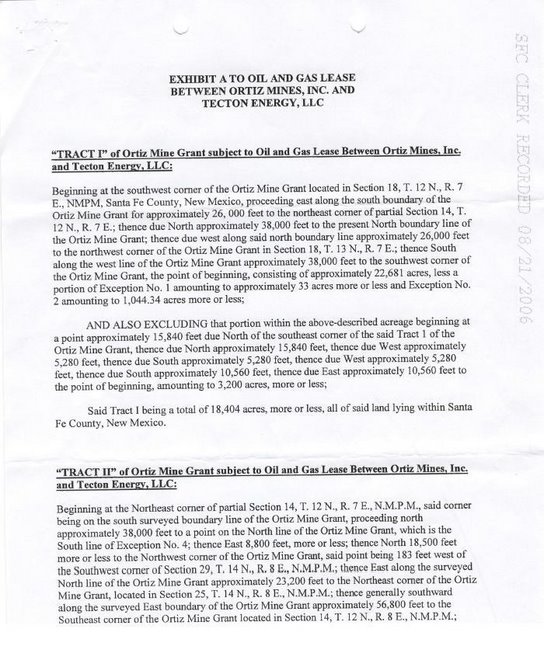
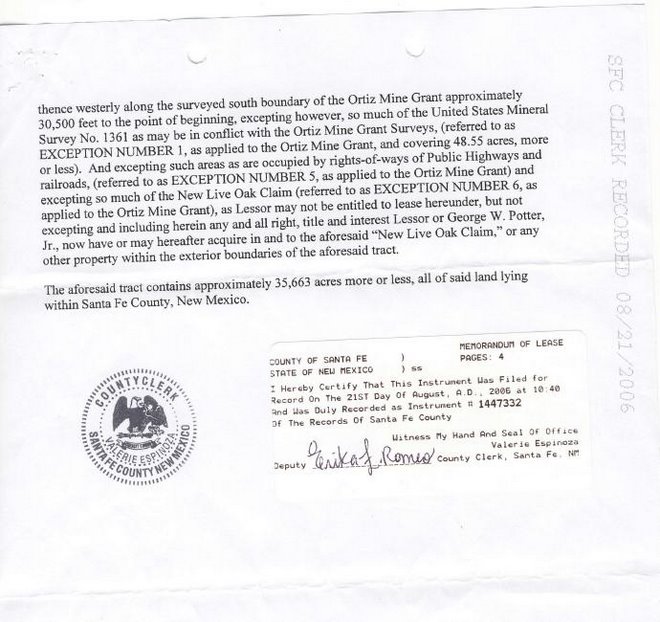
"The Gold of the Ortiz Mountains - A Story of New Mexico and The West's First Major Gold Rush," by William Baxter is not only a fascinating read, but puts the potentially impending black gold rush into context. Again, big interests have their sites set on the OrtizMountains area for mineral extraction (see memo Ortiz Mines, Inc. Memo of Oil & Gas Lease below).
Referenced Links: "Oil and Gas Exploration in Santa Fe County":
Disclaimer: All data and information provided on this site is for informational purposes only. drillingsantafe.com makes no representations as to accuracy, completeness, currentness, suitability, or validity of any information on this site and will not be liable for any errors, omissions, or delays in this information or any losses, injuries, or damages arising from its display or use. All information is provided on an as-is basis.